Mahanadi Coalfields IPO: Did You Get Shares, What Listing Day Brings, and How IPOs With an Unfilled Retail Quota Listed
Coal India sold 10% of Mahanadi Coalfields at ₹136 a share. Institutions bid for 4.95 times their quota; retail investors for 0.46 times theirs. So every valid retail bid at ₹136 gets every share it asked for. Of 28 earlier IPOs whose retail quota went unfilled, 17 closed their first day below the issue price. The bids, the allotment, the listing day, the dividends and the tax, from the prospectus and NSE's records.
Mahanadi Coalfields, the largest coal producer in the Coal India group, lists on NSE and BSE on Friday 27 November. Coal India sold a tenth of the company at ₹136 a share, the top of the price band, and receives about ₹8,981 crore before the offer's costs; Mahanadi itself gets nothing from the sale. The offer was bid 1.52 times over, but nearly all of that demand came from institutions. Retail investors bid for 0.46 times the shares kept for them. That has one plain result: a valid retail bid at ₹136 or at the cut-off price gets every share it asked for. This article explains the allotment and the listing day, shows what earlier IPOs with an unfilled retail quota did on their first day, and sets out what the prospectus says about the company and its dividends.
Written on 26 November 2026, the day before listing. The bids are NSE's consolidated count of NSE and BSE bids at the close on 23 November. The offer price, timetable, results and dividends are from the Prospectus dated 24 November 2026 on the company's website; the anchor allocation is from the company's letter to the exchanges of 18 November. The earlier IPOs come from the data behind this site's study of 298 IPOs: NSE's bid details and price history. The basis of allotment advertisement, which gives the number of applications in each quota, had not been published when this was written.
₹136 — the offer price, ₹130 for employees · 66.18 crore — shares sold by Coal India, 10% of the company · 1.52× — bids against shares on offer, all quotas · 4.95× — institutional bids · 0.46× — retail bids · 17 of 28 — earlier IPOs with an unfilled retail quota that closed day one below the issue price
The bids, quota by quota
The offer was 66,18,36,300 shares. Anchor investors took 16,87,68,255 of them on 18 November at ₹136, about ₹2,295 crore. The rest, 49,30,68,045 shares, were open for bids from 19 to 23 November.
| Quota | Shares kept | Shares bid for | Times |
|---|---|---|---|
| Institutions (QIB), anchors excluded | 11,25,12,171 | 55,68,11,640 | 4.95× |
| High-net-worth (NII) | 8,43,84,129 | 5,57,66,810 | 0.66× |
| Coal India shareholders | 6,61,83,630 | 3,73,88,230 | 0.56× |
| Retail (up to ₹2 lakh) | 19,68,96,300 | 9,14,49,380 | 0.46× |
| Employees | 3,30,91,815 | 72,71,330 | 0.22× |
| All quotas | 49,30,68,045 | 74,86,87,390 | 1.52× |
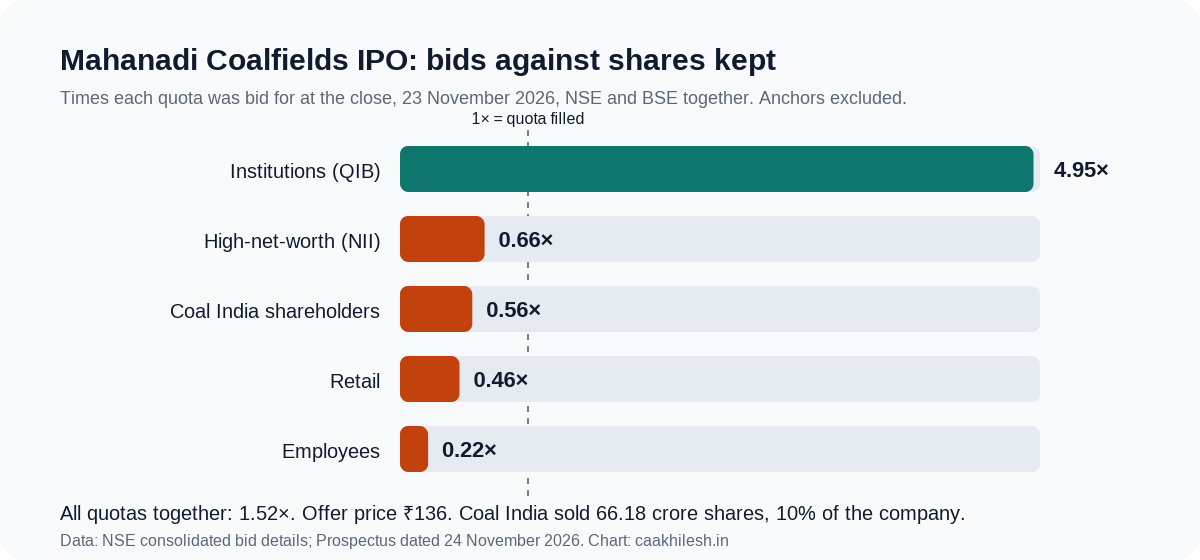
Mutual funds alone bid for 31.8 crore shares, nearly three times the whole institutional quota. Among anchors, LIC took 24.75% (₹568 crore) and 29 mutual fund schemes took 53.04% (₹1,217.5 crore). The individuals told a different story. In the high-net-worth quota, bids above ₹10 lakh came to 0.62 times and bids of ₹2 lakh to ₹10 lakh to 0.75 times. In the retail quota, 87% of the shares bid for were at the cut-off price.
Did you get shares?
Almost certainly, if your bid was valid. A draw decides retail allotment only when the retail quota is oversubscribed: then each applicant is first given one lot, as far as the shares go. Here the retail, shareholder and employee quotas were all short of bids, so there was nothing to draw. Each valid bid is allotted in full, whether it was for one lot of 110 shares (₹14,960) or for the retail maximum of 13 lots (₹1,94,480).
Three kinds of bid get nothing:
- Bids below ₹136. The price band was ₹129 to ₹136. Across all quotas, bids for about 45.3 lakh shares were priced at ₹129 to ₹135, below the price that was fixed. Bids at the cut-off price count as bids at ₹136.
- Bids whose money was never blocked. A UPI bid counted only if the mandate was approved by 5 pm on 23 November.
- Bids rejected on technical grounds, such as a PAN that does not match the demat account, or two bids from one PAN in the same quota.
Employees paid ₹130, after a ₹6 discount, and could bid for up to ₹5 lakh. Their quota was bid only 0.22 times, so bids above the first ₹2 lakh are also filled. An individual or HUF holding Coal India shares on 13 November, the date of the red herring prospectus, could put up to ₹2 lakh into the shareholder quota and still apply as a retail investor; both bids are filled.
The registrar is KFin Technologies. Status is on ipostatus.kfintech.com, by application number, demat account or PAN, and on BSE's application status page. The timetable in the prospectus: basis of allotment on 25 November, shares in demat accounts and unused money unblocked on 26 November, trading from 27 November. If money for a bid that was not allotted stays blocked beyond two working days after the close, the bank that delays it owes ₹100 a day or 15% a year, whichever is higher.
Where the unbid shares went
Outside the institutional quota, bids fell short by 18.87 crore shares: 10.54 crore in retail, 2.88 crore among shareholders, 2.86 crore in the high-net-worth quota and 2.58 crore among employees. Institutions bid for 44.43 crore shares more than their quota, more than twice the shortfall.
The prospectus lets unbid employee and shareholder shares move to the rest of the offer, and lets a shortfall in the retail or high-net-worth quota be met with "spill-over from other categories" at the company's discretion, with the lead managers and the exchange. A shortfall among institutions could not have been filled from other quotas, but there was none. So the whole offer could be sold, the extra shares going to quotas that bid for more than they were given, which here means mainly institutions. The exact count in each quota will be in the basis of allotment advertisement, which must appear before trading starts.
IPOs with an unfilled retail quota: how they listed
This site's study of 298 IPOs has NSE's bid figures for 297 mainboard IPOs that closed from 11 January 2024 and listed by 5 November 2026. In 28 of them, retail investors bid for fewer shares than the retail quota, as in Mahanadi.
- 17 of the 28 closed their first day below the issue price. The middle one closed 1.8% down. Across all 297, 85 closed below and the middle one closed 9.8% up. Where retail bids were three times the quota or more, 35 of 203 closed below.
- Twenty-one trading sessions later, about a month, 12 of the 28 were below the issue price and the middle one was 3.7% up.
- The spread was wide. On the first day it ran from Innovision, 27.9% down, to Juniper Green Energy, 15.4% up.
| IPO | Bids closed | Retail bids | All bids | First-day close | 21 sessions later |
|---|---|---|---|---|---|
| Hyundai Motor India | Oct 2024 | 0.50× | 2.37× | −7.2% | −6.6% |
| Afcons Infrastructure | Oct 2024 | 0.94× | 2.63× | +2.4% | +13.6% |
| Suraksha Diagnostic | Dec 2024 | 0.95× | 1.27× | −5.4% | −12.7% |
| Carraro India | Dec 2024 | 0.71× | 1.12× | −9.6% | −27.7% |
| Dr. Agarwal's Health Care | Jan 2025 | 0.41× | 1.55× | −0.1% | +3.2% |
| Hexaware Technologies | Feb 2025 | 0.11× | 2.66× | +7.7% | +3.6% |
| Aegis Vopak Terminals | May 2025 | 0.77× | 2.09× | +3.0% | +3.8% |
| The Leela (Schloss Bangalore) | May 2025 | 0.83× | 4.50× | +0.1% | −6.9% |
| Travel Food Services | Jul 2025 | 0.69× | 2.88× | −2.3% | +5.1% |
| BMW Ventures | Sep 2025 | 0.99× | 1.50× | −25.2% | −30.1% |
| WeWork India Management | Oct 2025 | 0.61× | 1.15× | −3.0% | −5.5% |
| Canara HSBC Life Insurance | Oct 2025 | 0.42× | 2.29× | +5.1% | +14.7% |
| KSH International | Dec 2025 | 0.86× | 0.83× | −7.6% | −9.1% |
| Aye Finance | Feb 2026 | 0.77× | 0.97× | −0.1% | −15.1% |
| Clean Max Enviro Energy Solutions | Feb 2026 | 0.06× | 0.94× | −17.6% | −20.1% |
| Omnitech Engineering | Feb 2026 | 0.33× | 1.14× | −9.7% | +45.3% |
| Sedemac Mechatronics | Mar 2026 | 0.20× | 2.68× | +7.3% | +26.2% |
| Rajputana Stainless | Mar 2026 | 0.27× | 1.12× | −7.4% | +8.2% |
| Innovision | Mar 2026 | 0.58× | 3.32× | −27.9% | −36.3% |
| GSP Crop Science | Mar 2026 | 0.40× | 1.61× | +11.3% | +28.6% |
| Central Mine Planning & Design Institute | Mar 2026 | 0.33× | 1.05× | −10.4% | +13.8% |
| Powerica | Mar 2026 | 0.15× | 1.45× | −1.3% | +21.8% |
| Sai Parenteral's | Mar 2026 | 0.12× | 1.05× | +3.5% | +30.1% |
| Manipal Health Enterprises | Jul 2026 | 0.93× | 4.92× | +13.0% | +23.1% |
| Juniper Green Energy | Aug 2026 | 0.93× | 7.97× | +15.4% | +17.8% |
| Horizon Industrial Parks | Aug 2026 | 0.96× | 1.45× | −3.1% | −11.2% |
| Varmora Granito | Sep 2026 | 0.995× | 1.58× | +2.8% | −18.1% |
| Zetwerk Manufacturing Businesses | Oct 2026 | 0.73× | 3.06× | −8.4% | +20.5% |
Coal India's two earlier listings this year point both ways. Bharat Coking Coal, in January, had retail bids of 49.33 times and all bids of 146.87 times; issued at ₹23, it closed its first day at ₹40.58, 76.4% up, and was at ₹30.10 on 25 November. Central Mine Planning & Design Institute, in March, had retail bids of 0.33 times and all bids of 1.05 times; issued at ₹172, it closed its first day 10.4% down and was at ₹181.16 on 25 November, 5.3% above its issue price.
Twenty-eight IPOs is a small group, and each had its own price, market and news. The record describes what happened; it does not say what Mahanadi will do on Friday.
What Mahanadi earns, and what it pays out
Mahanadi mined 218.31 million tonnes of coal in 2025-26, 21.0% of India's output and 28.4% of Coal India's, all of it non-coking coal from mines in Odisha's Talcher and Ib Valley fields. The prospectus, citing CRISIL, says it had the lowest cost per tonne among Coal India's subsidiaries, and it had almost no long-term debt: ₹1.95 crore of non-current borrowings at 30 September 2026.
| Year | Revenue | Profit after tax | Dividend for the year | Share of profit |
|---|---|---|---|---|
| 2023-24 | ₹31,634 crore | ₹11,842 crore | ₹8,600 crore | 73% |
| 2024-25 | ₹31,353 crore | ₹10,825 crore | ₹8,750 crore | 81% |
| 2025-26 | ₹30,550 crore | ₹10,698 crore | ₹8,400 crore | 79% |
| Six months to September 2026 | ₹16,093 crore | ₹4,881 crore | ₹5,150 crore paid by 13 November | — |
Revenue fell 3.4% and profit 9.7% over the two years to March 2026. In the six months to September 2026, revenue was 9.3% and profit 6.7% higher than a year earlier.
The price. At ₹136 the company is valued at ₹90,010 crore: 8.43 times its 2025-26 earnings of ₹16.13 a share, and 4.2 times its net worth of ₹32.29 a share. Its return on net worth was 53.77% in 2025-26. Coal India, at ₹385.00 on 25 November, was valued at 7.6 times its own 2025-26 earnings of ₹50.46 a share.
The dividends. Mahanadi has paid out most of its profit, all of it to Coal India, its owner until now. The dividends for 2025-26 come to ₹12.69 for each of today's ₹2 shares, 9.3% of ₹136. For 2026-27 it has already paid Coal India ₹1,850 crore for the half-year and ₹3,300 crore more between 1 October and 13 November: ₹5,150 crore, or ₹7.78 a share, more than its ₹4,881 crore profit for the half-year. Buyers in the IPO get none of that. The government's guidelines for its companies set a floor for future dividends: 30% of profit or 4% of net worth, whichever is higher. A floor is not a forecast. What new shareholders receive depends on what the board declares from here.
What the prospectus warns about
- One kind of customer. Power generation took 69.6% of its coal sales in the six months to September 2026, and government-owned power companies alone gave 41.7% of its revenue.
- Demand that may turn. CRISIL's report in the prospectus expects India's demand for non-coking coal to keep growing to about 1,564 million tonnes in 2035-36. After that, it says, demand may decline as renewable energy grows, and it puts power-sector demand slightly lower in each year from 2035-36 to 2037-38.
- Control stays with Coal India. After the sale Coal India holds 90% of the shares, enough to carry any shareholder vote on its own.
Listing day: how trading opens
On the first day, trading starts with a one-hour call auction from 9 am, under SEBI's circular of 20 January 2012. For 45 minutes, closing at a random moment in the last minute, buyers and sellers enter orders; the exchange then matches them at the price at which the most shares can be traded. That price opens the stock. There is no price band in the auction and market orders are not accepted, only orders with a price. Normal trading starts at 10 am, and orders that did not match move into it at their price.
The shares trade as MAHACOAL on NSE (ISIN INE03K401026). Anchor investors cannot sell straight away: half of their shares are locked in for 30 days from allotment and half for 90 days, so the first half can be sold from late December and the rest from late February.
Your allotment: what it is worth, and the tax
Choose the quota, enter the lots you got and a price to try. The tool shows the gain or loss, the securities transaction tax of 0.1% on a sale and the capital gains tax.
The calculator needs JavaScript. On one lot, every ₹10 a share above ₹136 is a gain of ₹1,100, and about ₹229 of tax if you sell within 12 months.
Tax if you sell or hold
- Sold within 12 months: 20% of the gain, plus 4% cess, under section 196 of the Income-tax Act, 2025. On one lot, every ₹10 a share above ₹136 is a gain of ₹1,100 and about ₹229 of tax.
- Held for more than 12 months: 12.5% plus cess, under section 198, on long-term gains above ₹1.25 lakh in the year from all your listed shares and equity funds together.
- Your cost is the price you paid for the shares.
- A loss can be set off against other capital gains (a long-term loss only against long-term gains), and what is left can be carried forward for eight years if the return for the year is filed by the due date.
- Dividends are added to your income and taxed at your slab rate.
Frequently Asked Questions
Did everyone who applied for the Mahanadi Coalfields IPO get shares? Every valid bid at ₹136 or at the cut-off price in the retail, shareholder and employee quotas is allotted in full, because each of those quotas got fewer bids than shares. Bids priced below ₹136 get nothing.
When were the Mahanadi Coalfields IPO allotment and listing? The basis of allotment was due on 25 November, the credit of shares and unblocking of money on 26 November, and listing on NSE and BSE on Friday 27 November.
How do I check Mahanadi Coalfields IPO allotment status? On KFin Technologies' site, ipostatus.kfintech.com, by application number, demat account or PAN, or on BSE's application status page. Your demat statement shows the shares once credited. Our allotment status guide walks through each site.
Why was the IPO subscribed 1.52 times when retail was 0.46 times? Institutions bid for 4.95 times their quota, and their extra demand was larger than the shortfall in every other quota put together. The prospectus lets unbid retail and high-net-worth shares be met from other quotas.
Is Mahanadi priced above or below Coal India? At ₹136 it is valued at 8.43 times its 2025-26 earnings. Coal India, at ₹385.00 on 25 November, was at 7.6 times. Earnings multiples are one measure among several.
Will Mahanadi Coalfields pay dividends? It paid every year in the prospectus, all to Coal India: ₹12.69 a share for 2025-26 in today's shares. The ₹5,150 crore paid for 2026-27 before the offer went to Coal India. Future dividends are decided each year, with a government floor of 30% of profit or 4% of net worth.
What did low retail subscription mean for listing in the past? Of 28 IPOs since January 2024 whose retail quota was not filled, 17 closed their first day below the issue price. That is a record of what happened, not a forecast.
Should I sell on listing day? This page cannot tell you that. If you sell within 12 months, the gain is taxed at 20% plus cess; after 12 months, at 12.5% above ₹1.25 lakh. The tool above shows both.
General information, not investment advice. This is not advice, and nothing here is a forecast or a recommendation. Past listings say what has happened, not what will.
This piece, as an infographic
Every figure on it comes from the piece above. Share it freely — a link back is all that is asked.
Sources
11 official sources, linkedMahanadi Coalfields Limited · Securities and Exchange Board of India · National Stock Exchange of India · KFin Technologies Limited, registrar to the issue and 1 more
The rules and figures in this article can be checked against these sources.
- Mahanadi Coalfields Limited: Prospectus dated 24 November 2026 (offer price, timetable, results, dividends, lock-ins, spill-over) Mahanadi Coalfields Limited
- Mahanadi Coalfields Limited: Red Herring Prospectus dated 13 November 2026, with the Abridged Prospectus Securities and Exchange Board of India
- Mahanadi Coalfields IPO: issue information and bid details, consolidated for NSE and BSE (subscription by quota, demand at each price) National Stock Exchange of India
- Mahanadi Coalfields: anchor investor allocation, the company's letter to the exchanges of 18 November 2026 National Stock Exchange of India
- IPO Allotment Status (search by application number, demat account or PAN) KFin Technologies Limited, registrar to the issue
- Public issues: current, upcoming and past IPOs, each with its issue information and "Name of the Registrar" National Stock Exchange of India
- Security-wise price, volume and delivery history of each share National Stock Exchange of India
- Call auction in pre-open session for IPOs and other category of scrips, circular CIR/MRD/DP/01/2012 of 20 January 2012 Securities and Exchange Board of India
- SEBI (Issue of Capital and Disclosure Requirements) Regulations, 2018, as amended to 21 March 2026 (regulation 49: minimum allotment) Securities and Exchange Board of India
- Income-tax Act, 2025, section 196: tax on short-term capital gains in certain cases Income Tax Department
- Income-tax Act, 2025, section 198: tax on long-term capital gains on shares and equity funds Income Tax Department